What the freak is a zettlekasten??
Zettlekasten is a German word, which means slipbox. German: so it’s a russian doll of smaller words; zettle means “slip of paper” and kasten means “box” or “crate.”
THE Zettlekasten, however, refers to a note-taking system made popular by a German sociologist and philosopher called Niklas Luhmann, who actually looks like he was sort of a hunk.
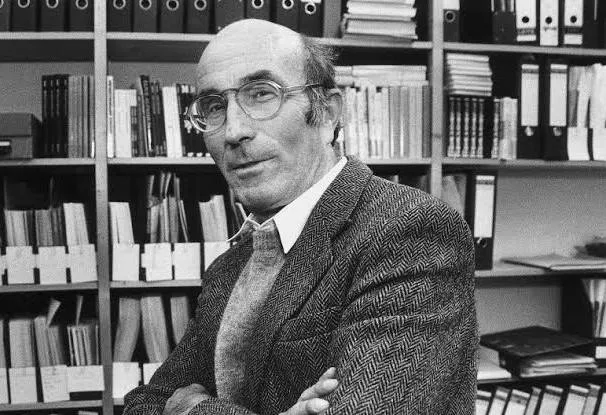
The lore around Luhmann is kind of insane. He wrote a ton:
“Luhmann wrote prolifically, with more than 70 books and nearly 400 scholarly articles published on a variety of subjects, including law, economy, politics, art, religion, ecology, mass media, and love.” 1
He got his PhD because two of his books were so good (and his research, so fire) that the University of University of Münster offered him a professorship as well as a doctorate.

To all of this success, Luhmann gives credit to his Zettlekasten: a system of keeping and connecting notes.
How to Keep a ZettleKasten
Here’s how it works: you start with an empty Zettlekasten and no notes. Then you have an idea… you write it down on a single piece of paper or on a single document.
If your idea is actually 3 ideas all smashed up into one, you split them up into three ideas and write them out on three separate notecards. Each notecard, or document, should represent a single atomic note.
Perfection. Your zettlekasten has some notes in it.
Actually, for this, let’s just say you only have 1 idea in your zettlekasten.
The fun starts when you get another, second idea. You write down this idea, and if you can, you connect that idea to the one that’s already in your slipbox.
Maybe having the two ideas next to each other will cause a chemical reaction that will form new idea! Marvelous!
You can connect ideas any way you want. Those connections could be the beginning of a train of thought. Or you could be providing some color that’s something slightly unrelated, or it could be an opposing idea to the note you already wrote down. Generally, the process of adding a new idea to the slipbox involves challenging, extending, and complementing ideas already in your slipbox 2.
If the two ideas are totally unrelated, you can also keep them seperate, but either way, this is the process:
- Write down any idea that interests you or captures your attention.
- Add it to your zettlekasten by linking it to other ideas in the zettlekasten.
Perks of a ZK
When I started, I had a suspicion that keeping a zettlekasten is sort of like pruning a bonsai tree and that it really matters how you keep it. Not just whether or not you’re following the “rules.” But something else.
Maybe Luhmann was going to be prolific no matter what, and his zettlekasten was just a weird and un-understandable thing that he did as well.
I’ve only been doing this for a couple months, so it’s hard to say if it’s really made me more productive or insightful or anything like that. It has helped me to write more, though, so that’s a win. Generally, I’ve just enjoyed the process. Here’s why:
1) it helps me remember what I’ve been repeatedly interested in
The whole pride and joy of using a zettlekasten is to not write an essay or an article or anything! if you don’t want to.
When people asked Luhmann how he was so productive, he said it was because he followed what was interesting to him. When he was stuck, he would move on to the next thing, always keeping multiple projects going at once 2.
What a butt.

But it’s a nice concept, and the zettlekasten encourages it: to write down what interests you without worrying too much where to put it.
And the output of simply writing down what interests you, is that you will start to form these clumpy chains of thought within your zettlekasten.
If you keep coming back to something, if you keep turning the problem over in your head, thinking through all of its different attributes, all of its sides of it – If the problem has sides: different portals to explore or ways to view the problem – then your zettlekasten will eventually grow to reflect that.
What I’m trying to say, is this: if the thing you’re thinking about is either complex enough or interesting enough that it’s taking you some time to wrap your head around it, then you’re going to have a bunch of notes in the zettlekasten that refer to this problem.
Shower thoughts, thoughts that seem TOTALLY unrelated, but… aren’t!
Your zettlekasten will grow into this clumpy chain of thought that puts words on and around your idea / problem / ??? / whatever it is that you are repeatedly coming back to. It’s helped me to understand the types of things that I find compelling or attention-grabbing, and it’s been fun to spend more time with those types of things.
2) it’s FAST and EASY and it’s a way for me to put all of my ideas somewhere
There’s something nice about putting all of your random notes somewhere and knowing that you’re going to come back to them.
My brain can feel super chaotic sometimes. So it’s nice to have a landing pad for all of these random thoughts to go.
Keeping a zettlekasten has also lowered the barrier of entry for me to write something down. If I have an idea, I write it down, and I know that sometime within the next week I’ll go through all of those ideas and just see what we got. Making this a fast and easy process makes sure that nothing gets left out.
ZK principles
These are some of the principles of keeping a zettlekasten that I’ve found helpful.
- The ZK was made for speed. Adding notes should be easy. You want to get all of your ideas in there don’t you??? Then make it really easy to add new notes.
- The ZK doesn’t have to be perfect. The slipbox is a septic tank. Let it stew.2
- The ZK should be hungry for linking. Cross-pollinate ways of thinking from one subject area to another.
- ZK needs atomic notes. Atomic notes allow for better linking.
- The ZK should be surprising and fun to work with.3
ZK terms
Terms that are useful. You’ll find these in other zettlekasten explanations.
Fleeting Notes - notes that you’ve written down, but haven’t gone through the trouble of connecting to any other notes to your slip box. This is the super easy landing zone for any and all ideas.
Permanent Notes - all the zettles in your zettlekasten. These are the ideas that are connected together into a web or matrix of ideas. Exciting!
Literature Notes - These are ideas on little slips of paper too! But these ideas come from books, or articles or youtube TV and should include a little citation so that you can find the idea in the source if you need to (or want to put your stuff in a paper). I’m not sure if this is right, but for me, all my notes land in Fleeting Notes, and then they reach their final form either in Permanent Notes, Literature Notes, or the trash can.
References
-
How to Take Smart Notes by Sonke Ahrens, published in 2017 ↩ ↩2 ↩3
-
Niklas Luhmann: Communication with Zettelkastens. An experiential report ↩